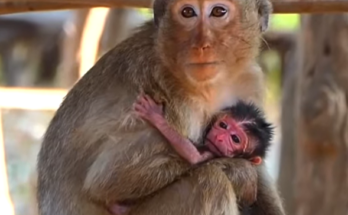
Under the dim early morning light, the forest floor was still quiet when the tiny newborn hybrid baby monkey entered the world. Its fur was soft, still slightly damp from birth, and its eyes blinked slowly as it tried to understand its new surroundings. However, what should have been a moment of comfort and connection turned into heartbreak. The young mother, inexperienced and overwhelmed, did not welcome her baby with warm arms. Instead, she refused to hold or nurse the little one. The baby tried to cling to her, but she pushed him away, forcing him backward onto the cold ground.
The newborn cried in soft, weak sounds, the kind that showed confusion more than pain. He had only one instinct: to search for his mother’s warmth and the nourishment he desperately needed. But the mother, still nervous and unsure, kept turning away, nudging him aside whenever he crawled near her. Her body language was restless, pacing and shifting, as if she did not understand that this tiny life depended completely on her.
Other members of the troop looked on with mild curiosity. Some came close, sniffing the little one as he tried to lift himself again, only to be pushed down by his mother’s hand or hip. Each push left him lying on his back or side, small fingers stretching helplessly toward the air. His cries grew louder, trembling with sadness and need.
The mother monkey’s rejection came not from cruelty but confusion. Hybrid babies sometimes look slightly different, and in some troops, unfamiliar appearance can cause uncertainty to a new mother. She seemed unsure whether the baby belonged to her. Her young age and lack of maternal experience added to her hesitation. It was heartbreaking to watch her stand only a few steps away as her baby cried for her, without understanding how to respond.
The baby, though tiny and weak, continued to try. He rolled, crawled, and reached, hoping that if he could just touch her chest, she would remember her role. His determination was pure instinct—life calling out for connection.